Posts

Showing posts with the label dog

Why Rabies Vaccination is a Whole Other ... Animal

Image
I just read about a pet cat in BC that was euthanized after it was found playing with a bat.  The bat was caught, euthanized and sent for testing. It came back positive for rabies. The cat was not up-to-date on rabies vaccinations and the owners could not afford to board the cat for the 90 day quarantine that was required*. That only left government-mandated euthanasia - the government has no flexibility with these rules.  This is really sad - they had kids which makes this suck that much more - and illustrates one of the reasons why I encourage vaccination, including rabies vaccination. I won’t get into the over-vaccination debate here, as rabies vaccination is a whole other ... well ... animal. * This can be expensive: $40-$50 per day is not uncommon, so quarantine could have cost the owner $4,000 or more What Is Rabies? Rabies is a virus that is passed in the saliva of infected animals and enters the blood of its victim via any route it can (e.g. through a bite wound or muc...

Getting Tutored on Spays and Neuters

Image
I had a comment come in through Google asking about the cost of spay/neuter at our clinic. A great question that is often followed by another great question, "what is the difference  between a spay and neuter?" Fear not! I will sort it out right here, right now. Note : At the end of this blog, we'll discuss cost and the differences in what's included between veterinary clinics (hint: price is not everything when it comes to surgery on your pet ). All About Spays and Neuters Overview Spays and neuters are sterilization  procedures. When we speak of animals, sterilization does not mean that we're cleaning them really well, but rather that we are removing their ability to have babies.  There are a few ways this can done (for example, surgically or with drugs), however spay  and neuter  have specific meanings, as well as additional benefits beyond preventing unwanted puppies and kittens. What are Spays and Neuters? Spays and neuters are surgical procedures that rem...

What the Heck are Anal Glands?

Image
 This topic stinks! 💩 But it's a good thing for dog owners to know about. What Are Anal Glands? Anal glands are located near the rectum and add scent markings to feces. Now doesn't that make you want to learn more?  😜 Where Are They? Anal glands (also called anal sacs) are small sacs just inside the rectum of dogs. There are two of them at around the 4 and 8 o'clock positions (one on the right side; one on the left side). Each sac has a single small opening just inside the anus.  What Do They Do? Inside the anal gland, dogs produce anal gland secretions. The secretions are stored in the glands and released when a dog defecates (poops). (Hope you're not eating dinner while you read this  🍽️ ) That Stinks! Yes! Because it's supposed to! Anal gland secretions are the consistency of ketchup, typically light brown in colour, and have a very  distinct smell... That's really unpleasant! ...Which is the point: Anal gland secretions are used as a "calling card...

What Does Listening to Your Pet With a Stethoscope Tell Us?

Image
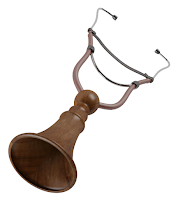
The humble stethoscope is synonymous with medical care. It's literally the first medical tool we get as doctors, and it's a part of our identity. But what do we actually learn  when we listen to your pet with a stethoscope? To find out, let's start by figuring out how a stethoscope works. How a Stethoscope Works Old-School Stethoscope A stethoscope works by simply amplifying the sounds of whatever it's pressed against. It's a really old-school medical instrument: It's literally just a hollow tube with one end enlarged to amplify sound (the end against your pet) and the other end narrowed to allow us to hear the sound (the end we poke in our ears). Sounds Good Firstly, it's important to understand that sound is simply waves of air. These waves of air push on our ear drums, causing them to wiggle and, through a series of complicated maneuvers in our middle and inner ears, gets turned into nerve impulses which our brain interprets as sound. The stethoscope turn...

Why Brush Your Pet's Teeth?

Image
 Pets Have Teeth Too! Brushing your pet's teeth is something I really believe in - I can usually tell whether an owner brushes their pet's teeth regularly - it makes that much of a difference. And you can bet your pet feels the difference (imagine not brushing your teeth for a few days ... a few weeks ... a few years  ... you get the idea).  What a Healthy and Unhealthy Mouth Looks Like The difference between healthy and unhealthy teeth and gums is easy to spot! This is something you can do at home easily. Just "flip a lip" and have a look! Healthy Teeth and Gums Healthy gums are pale pink, nearly flush with the teeth (they don't protrude out from the teeth) and aren't painful when touched. Healthy teeth are a bright white, solidly rooted and not cracked, chipped or broken. Note: Some pets have areas of pigment on their gums (often black vs. pale pink); this is not a problem 😅 Unhealthy Teeth and Gums Unhealthy gums are dark pink to red and can be swollen. Th...